Saturday, 26 November 2011

Teaching Climate Change

What is often portrayed as a debate is, and always has been, no debate at all. There are not two legitimate sides on the issue of climate change. There is the truth and there are people that want to ignore the truth. I have not yet heard an argument that refutes human caused climate change that stands up to scientific scrutiny.

I wonder what people are so scared of in admitting there is a problem, and then working towards solutions. I just happen to be glad that those people are not teaching science classes here in Alberta, at least they had better not be.

Here is a nice breakdown of the actual science behind the theory of human caused climate change called the Climate Change Skeptic Comic.

If a comic about climate change isn't good enough for you then please read on for a variety of sources on the  reality of human caused climate change.


I want to challenge teachers to teach the theory of human caused climate change in their classrooms. Not as a debate with two equally legitimate sides, but as the best understanding that science has to offer. The equivalent would be teaching in the sixties about the civil rights movement in the U.S. and segregation and placing the Ku Klux Klan as an equal and valid argument next to the Reverend Martin Luther King Jr.


There were many many people aligned with the guy on the right making strong arguments in favour of their point of view, but they were bloody wrong, and I don't think teachers working in critical thinking classes should have been presenting both points of view as equally legitimate out of some misplaced sense of being balanced and allowing students to "think for themselves" or to "tolerate conflicting points of view."

Take a look at what the deniers of human caused climate change are saying (these are arguments that people  have made to me in person, you have heard most of them, and my response to those arguments):

  1. The Scientists are in it for themselves - This argument should be stricken as utterly ridiculous as soon as it is heard. The idea that there is some kind of global conspiracy where Al Gore has the IPCC and other independent climatologists in his back pocket is downright absurd. Sure there are political opportunists, and some people trying to make money, but the reality is, if there is any kind of payout to  scientists to distribute non-truths it is not coming from climate change scientists. The possibility of conspiracy is definitely there, but it is big oil paying PR firms to legitimize the skeptics. When Exxon Mobil pays authors to write that climate change isn't real then there is a conspiracy to prevent the truth from coming to light, "nine of the ten most prolific authors cited have links to organisations funded by ExxonMobil"
  2. If you aren't convinced, then ask your self this simple questions. What  exactly do the overwhelming majority of climate change scientists have to gain from publishing their findings? How do the scientists benefit from "lying" about human caused climate change? Is Al Gore sending them a check? Is Greenpeace so powerful an organization that it can manipulate the scholastic fortitude of top universities around the world? The argument is profoundly absurd.
  3. The Climate is always changing - That is true, but it has not been this warm in over 650,000 years. The evidence from NASA's (NASA isn't exactly a liberal media tool) site on climate change is overwhelming. If we were cooling and entering another mini-ice age it could easily be argued that the climate is behaving normally, but there isn't evidence of this kind of global warming in any geophysical historical record. NASA - Climate Change Evidence. The science states: "In the last 650,000 years there has been seven cycles of glacial advance and retreat. Most of these changes were due to small shifts in the Earth's orbit.... the evidence for rapid climate change in modern times is compelling." The best argument that I like to use to counter this ignorance is the FACT that even the U.S. Navy is planning how to navigate and control the arctic sea once the ice there is gone. By around 2030 the US NAVY is planning to have an arctic free of ice.
The signature at the bottom of this actual report about how the US NAVY will handle climate change is J.W. Greenert Admiral in the U.S. Navy


  1. The Economy will be hurt - Only if we are not smart about this, yes there will be risks to changing from a fossil fuel economy to one that is driven by alternative energy, but the economy, or the society, that steps up first will be able to make money in the transition. There will be jobs, there will be energy exports, and we, as a species, are intelligent enough to continue finding work are experiencing prosperity without fossil fuels. Will manufacturing disappear? Will resource extraction and refinement be completely dismantled? Of course not. The new information economy will grow and develop, creative efforts will find new economic space, and the innovation sector will allow for growth, opportunity and prosperity. The truth of the matter is that ignoring climate change will be more costly than anything else in human history. This NRDC (Natural Resources Defense Council) report paints a bleak, but all too real warning about, The Cost of Climate Change. Granted they are an interest group, but their findings are well referenced and properly researched. Warnings that we have all heard, but choose to ignore are reported on. From the impact on agriculture - a sector that has built and continues to maintain both North American and European global economic superiority - to the cost of rising sea levels and a look at playing catch-up in the global energy market.
How much will losing our agricultural strength hurt our economy? 

Teachers, it is your duty to educate students on the truth behind Human Caused Climate Change. I hope the ideas, arguments and links above will help you to fulfill that moral and ethical responsibility. This is not a debate, in the same way that slavery was never a debate, and that segregation was never really a debate and that women's equality was never really a debate. There is truth and there is ignorance, it is your duty to help reveal the truth and expose the ignorance.

Wednesday, 23 November 2011

Isaac Asimov on Education and Learning

I am finding more and more informal mentors in my professional growth and learning. There are people that have done things and learned things and have great ideas around me all of the time. When I ask them questions and look to them for guidance they become and informal mentor to me. I draw on their experience and knowledge to help guide my own ideas and practice.

There are a few people in EPSB that I consider my informal mentors. I have encountered them in various Ed. Tech. training sessions and particularly at the Goolge Apps. info and sharing seminars. One of my informal mentors, Rick Stiles-Oldring, recently pointed me to a video interview of Isaac Asimov that is truly astounding.

Rick blogs at Heeding Thamus and he can be counted on to provide challenging, insightful and occasionally annoying ideas, both on his blog and in person. The reason I say annoying is because some of his ed. tech. ideas end up challenging my core assumptions about technology and learning. When a "core" assumption is challenged it means I have to re-examine and also alter most of my thinking. I have always assumed that a schools network infrastructure should stay platform neutral, any system can be supported. That is until Rick comes along with an idea that has been nagging at me for a week now. Isn't there value in platform equity? Shouldn't schools provide, especially considering the rapid decline in cost, the same platform for each student? Don't schools already have the resources to provide every student with a cheap and identical network tool? Like say a tablet or a chrome book?

I have spent the last two years thinking that the future of ed. tech. in the classroom was to increase student owned devices, now I am not so sure... thanks Rick!

This was supposed to be a post about Asimov. Watch the video below:
.

Key Ideas

  1. Lifelong learning is not just for the young - especially with the internet and open access to learning. Free education at Stanford!!
  2. Everyone can become creative - we were able to teach reading and writing to all youth, why not creative thinking?
  3. The teacher can be eliminated. Everyone now has their own personal teacher (source of knowledge and information) at their fingertips.
  4. Interactions with other students and teachers is still needed. School has a role to play, but not the same one as before. What is that role?
  5. If you follow your own bent, and aren't told what to learn then learning will increase. This one is key!!! Let students find their own interests and follow it for real learning, and find your own. Be the sole dictator of what you learn, and allow your students to be the dictators of what they learn.
Thanks for sharing this video Rick.

Monday, 21 November 2011

Who is Protecting Whom?

I have to put this out there as much as possible.

I remember hearing the president of the U.S. as being referred to as, "the leader of the free world."
I don't know if we can still call the U.S. a member of the free world.

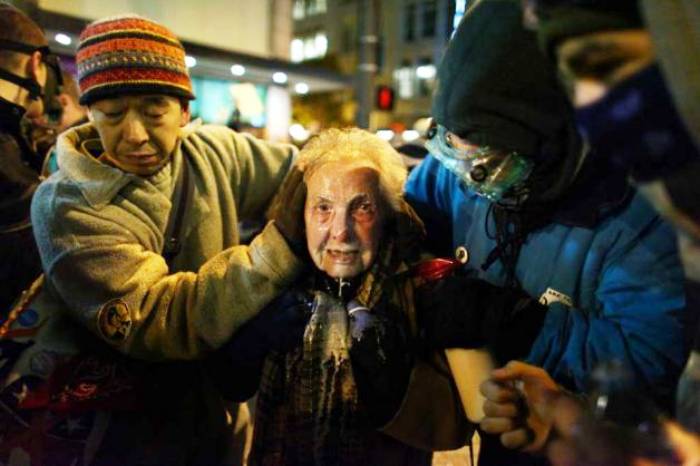
Pepper Spraying at UC Davis on Friday

This is one image among many that are revealing police brutality in response to Occupy movements across America.

Here is the video of an Iraq and Afghanistan War Veteran being needlessly beaten by police in Oakland


...and of course, this 84 year old grandmother was such a threat to public safety in Seattle that she had to be pepper sprayed.


Exactly who and what are these police protecting?????


Monday, 7 November 2011

Keep Your "Opinion" to Yourself

Maybe it is written into my professional code of conduct, or maybe it is just common practice, but wherever it comes from I am tired of keeping my "opinion" to myself.

To be honest, I don't actually mind keeping my mouth shut on issues, controversial or not, because it makes the students think for themselves, and that is what this whole thing is about, but there are one or two ideas that I fervently support in my own life which I am having a hard time keeping to myself.

Image taken from google without permission

I'm not going to beat around the bush today. I am going to jump out and say it. These two ideas that follow are supposed to be kept to myself. I do such a good job of this I doubt if my students this year would even be able to tell you how I actually feel (do you see, I am beating around the bush even though I said I wouldn't, and that somehow counts as being clever at 11:00 p.m. on a school night). 

My first "opinon" that I try so desperately not to poison my students with is that, I am an environmentalist.
This is first image in a google image search
 of environmentalist - lazy or making a point?
What being an environmentalist means is something that I will talk about at the end of this post (if I remember), but there is the bigger issue that I as a role model to students am supposed to keep my mouth shut about this idea. A professional should not have an opinion??? I can still present the industrialist argument  with some degree of merit, but why shouldn't an informed citizen model what being an informed citizen actually looks like? 

My editorial confession #2, I am also the 99%,and I support the major tenets of the occupy movement, and of course there are major tenets. Just because many of the confused anarchists in the movement can't adequately express why many people are making valid complaints about the current power and wealth structure does not mean there isn't a focus or clear reason to the protest.


I see the world in a certain way, and I will make a professional guarantee that I will never force, coerce or unfairly persuade a student to see the world from my point of view, but that does not mean I will not present my own view of the world. The argument runs that as a trusted teacher I will have undue influence on a child's point of view. I counter, that is only the case if that is my intent. When the issue is contestable then my opinion or worldview needs to be presented as valuable, but also deeply flawed. It is our responsibility to have an informed opinion, but to present it as only that, one person's opinion. 

So what about when the issue is so completely clear? Even though some still consider it a debate?

For example, What Goldman Sachs did was wrong, and we should be able to discuss the economy without blind allegiance to the free market, talk about preaching an "opinion" as if it were truth. Here is Elizabeth May on the topic, “Excuse me, but are the lunatics running the asylum? Can’t we have a healthy economy, and yes, even capitalism and corporate profits, that serves the interests of communities and that accepts its marching orders from democratically elected governments?”

Okay I need to focus.

The main point I want to make (which I haven't even done a mildly adequate job in alluding to up to this point) is that according to every valid source that I read is pointing to the fact that human caused climate change is a reality, one that is having and will continue to have devastating effects on humanity and life on Earth in general, so why the hell am I teaching the topic as if it is a debate between environmentalists and industrialists?


Wednesday, 2 November 2011

Professional Growth Plan

Like everything in teaching, if you want your students to do it you should be able to do it. Also, if I truly believe in the changing nature of knowledge transmission and the shift to a visually based on demand style of expression then why would I write the same old two-page Professional Growth Plan..

Those Darn Infographics are tough work. btw the last slide is supposed to be an infographic.