Gordon Bethune, CEO at Continental from 1994 - 2004, was able to transform continental from an industry to joke to one of the top airliners in the United States. He managed the change that he knew had to take place. He did this thoughtfully and with purpose. The way that he achieved the successful transformation is why we study this case.
He lived the change efforts that J.P. Kotter describes in his article, "Leading Change: Why Transformation Efforts Fail." I could take a walk through Kotter's eight steps for successful transformation that Kotter has provided for us, pointing out how Bethune had accomplished each step from motivation through to institutionalization, but I want to talk instead about the essence of Bethune's success.
Bethune was successful because a) he knew his industry, b) he had a successful strategy that he was able to communicate and c) he was able to get the most out of his employees. These ideas have been covered to some degree throughout the course and cases studied, but a few things in particular stand out as new lessons that I can take from this case and as lessons that have been so often repeated that I am sure to never forget them. I will start with the latter.
Since day one of this class it has been made very clear that in order to get the most out of employees leaders must treat them as adults. Adults need to be trusted, they need to be given autonomy over their decisions, and they need to be treated with dignity and respect. Bethune trusted his employees and he let them know this by getting rid of security cameras. Bethune gave his employees autonomy and he symbolically burned the old order of management in the parking lot. Bethune gave his employees information when they deserved it, even when that meant they were being let go. Time and time again in this class there is a truth coming through - employees must be treated as adults.
We haven't talked quite as much in this class about strategy. That is a topic that is most likely more industry, or situationally specific. We are talking about managing people here, not about managing business plans. However, it is clear from Bethune's case at continental that his strategy was one of the primary reasons that he was successful. His employees knew this as well. He was able to communicate the needs to be maintaining fewer aircraft. He was able to help his employees focus on customer satisfaction, and he gave the employees the tools to communicate the needs of the customers.
Bethune also knew his industry. Gates is another perfect example of why having a leader that is an expert in the field as the leader can be the best way to ensure a sustainable competitive advantage. Skilling helps prove this argument because he entered an industry that he really did not know very much about. Yes, Skilling took Enron in another direction, but he did not really understand or respect their core competencies. Not every business or organization needs an expert in the field at the helm, but Bethune and others show that it certainly helps.
There are two other big ideas that fit together nicely, but not into the scope of what I mention above.
Much of this course unexpectedly took meaningful forays into the field of psychology. This makes sense to me now that I am at the end of the course because if we are discussing motivation, retention and maximum productivity of human beings, then of course you have to understand the human mind. Bethune and contintental reinforce the idea from class about the importance of an employees psychological ownership in an organization. Providing employees voice can be the most powerful method of getting important on the ground information from employees. Another interesting psychological take away from this case (sorry this paragraph stinks) is the importance of symbolic gestures. Burning books, unplugging cameras and hosting a house party are small investments of capital and energy, but they yield enourmous payoffs in the minds of employees.
Symbolic gestures and psycholigcal ownesrhip. Using these two forces and all of his other strengths it is no wonder that Bethune was able to motivate his employees, create and communicate vision, empower his employees, create short term psychologcal wins, consolidate his changes and institutionalize his new approach.
Monday, 31 March 2014


Monday, 24 March 2014
SMO Reflection Post #9 Managing Transformation
When asking questions in class about this week's article written by Kotter my curiosity must have sounded too much like criticism. Before I can begin to accept any authors ideas and findings I have to be aware of their process or methodology. Not because I require it in order to be convinced, but because I often find it more interesting than what they are saying. I was drawn into Kotter's article right away, and of course I noticed his opening remarks that, "over the past decade, [he] has watched more than 100 companies try to remake themselves into significantly better competitors." This introduction had instant appeal for my eye to process and source information. Was he talking anecdotally or hyperbolically? What did he mean by watched? Does he mean studied? Or did he collect stories from friends in the various companies? Did he study other cases written primarily by other academics or did he review accounting reports and HR documents from these companies?
I like operating from the vantage point of naivete where I can question such giants in the field. This is yet another occasion where I can be excited by my own ignorance because I am being shown again and again how little I actually know. The choice I made to pursue this degree rather than a second degree in education continues to prove to be the correct choice.
The amount of information in Kotter's article that I will be able to use for my personal leadership style (set of management practices) should be easy to incorporate. Motivating employees and helping them see the need for change, and then pointing it out over and over makes so much sense. Far too often leaders try to implement change, but the leaders are the only ones who see the necessity. Not enough energy is given towards getting key players on the side of change. The Culture of any organization is already teeming with power and relationships, and leaders need to understand this dynamic in order to leverage it to help them fulfil own vision. Organizations would be far better served, of course by helping team members see it as their shared vision, but first the leaders need a clear idea of what that vision is. The vision must be clear, and it must be communicated to everyone over and over and over. If people have questions about it they need to be answered in a way that pushes the vision forward, but still respects the people asking the question. Kotter's description of why Transformation Efforts Fail reads like a how to guide in opening people eyes.
Maybe it's the quote from Socrates above, but isn't Kotter talking about showing people the drawings on the cave, making sure they follow the leader into the truth, accepting the reality once they see it, and not letting them turn around again into the darkness? ""And suppose once more, that he is reluctantly dragged up a steep and rugged ascent, and held fast until he's forced into the presence of the sun himself," I know any actual philosopher would be horrified at this comparison, but isn't wisdom all we are really talking about in this text? For the Leader to reveal his own mind and understanding to the other thoughtful beings that do not always see the truth of the situation!
Jean Creping, CEO of Norwest Labs, was a brilliant individual, but he was not an effective leader. He saw the truth and he was not able to show that truth to the people around him. In order for his company to have created a long-term sustainable advantage, he needed to lead his employees out of their roles, show them what he knew in his own mind, and help them to continue to work in the new reality of his struggling company. Leaders are able to tap into the resources around them and show them the truth of their situation. All responsible and reasonable adults are ready to listen and respond to the leaders guidance, but they have to understand urgency. They need to accept that the new status quo is necessary. Crepin was incapable of accomplishing this.
I'm sure there is more to say about the effectiveness of gain sharing in certain industries and there is more to say about why Open Book Management helps empower employees, but if the humans that are in the organization do not understand the reason, the vision or the businesses reality than any strategy will be doomed to fail.
I like operating from the vantage point of naivete where I can question such giants in the field. This is yet another occasion where I can be excited by my own ignorance because I am being shown again and again how little I actually know. The choice I made to pursue this degree rather than a second degree in education continues to prove to be the correct choice.
 |
| All I Know is that I Don't Know Nothing |
Maybe it's the quote from Socrates above, but isn't Kotter talking about showing people the drawings on the cave, making sure they follow the leader into the truth, accepting the reality once they see it, and not letting them turn around again into the darkness? ""And suppose once more, that he is reluctantly dragged up a steep and rugged ascent, and held fast until he's forced into the presence of the sun himself," I know any actual philosopher would be horrified at this comparison, but isn't wisdom all we are really talking about in this text? For the Leader to reveal his own mind and understanding to the other thoughtful beings that do not always see the truth of the situation!
 |
| Forgive this self-indulgence |
I'm sure there is more to say about the effectiveness of gain sharing in certain industries and there is more to say about why Open Book Management helps empower employees, but if the humans that are in the organization do not understand the reason, the vision or the businesses reality than any strategy will be doomed to fail.
Monday, 17 March 2014
SMO Reflection Post #8 Intrinsic and Extrinsic Motivators
While the NHL lockout article was interesting to read I don't really want to write about it. In the same way that the topic of union management conflict is interesting, I don't really want to write about that either. I guess I did learn a little bit about the history of the relationship causing conflict in the present and trust is essential in bargaining and having the public involved can complicate things, but I don't want to write about it.
What I want to write about is motivation. It turns out that I can't write about motivation without writing about Herzberg, so that is where I would like to end up, but I do want to reflect on my understanding of the second required reading before I move on.
While reading, and subsequently discussing the article, The Importance of Pay in Employee Motivation, I was struck by the how much my understanding of the ideas changed in a short amount of time. When I initially read the article I was overly critical of the conclusions because I thought it was arguing that pay is a way more important motivator than we give it credit for. "That can't be right, everything I am learning up to this point states otherwise." So I went and looked at the sources of these conclusions. All of this work is based on a number of large and diverse meta-analysis. "Wait a minute, that is real and undeniable data, despite my opinions I have to adopt the authors conclusion because it is so well researched." I thought. "Now I will argue that pay is fundamentally important to employee motivation, and I will cite this article as I say it." Then I went to class, and I had my ideas altered again.
It turns out I was missing the point of the article, so for the sake of my own reflection I will state my current understanding of the articles conclusions, and I apologize if it sounds like I am regurgitating our professors comments on the idea.
Rynes, Gerhart, adn Minette were not arguing that pay is the key motivator in employee performance. They were arguing that pay matters up to a certain point. That in the HR subfunction of attracting and selecting candidates it matters a great deal. That in the HR subfunction of retaining employees pay still matters quite a bit, especially if the employee can find the same job for more pay at another firm, then it matters. However, once an employee has agreed to work at a certain wage level or salary, then pay will not be a significant factor in motivating employee performance. If there is a big differentiation in pay for performance, a significant change in what an employee will be paid based on performance, then it can still motivate, but the reality is that rarely ever happens in performance based pay systems.
In other words: yes pay matters, but only up to a certain point, after that motivation needs to come from intrinsically motivating factors.
okay now the more interesting stuff. The intrinsically motivating factors. Even though I have keep coming back to Pink and Drive, this time I get to look to Herzberg for an exploration of motivating employees. As I write this next section my goal is to a) review his main ideas and b) apply his ideas to a school setting.
In his classic article One More Time: How do you Motivate Employees? Frederick Herzberg writes as if he is living in the 1960's. He is, but still, opening the piece with a metaphor about rape, and then saying it is prefarable to seduction? What the hell is this? but looking past this very strange introduction there is something very important being said here. So forget all about KITA and the rest of his nonsense.
When compared to basic drives such as hunger Herzberg juxtaposes another set of needs that "relate to that unique human characteristic, the ability to achieve and, through achievement to experience psychological growth." Herzberg relies on the psychological reality of human beings in the workplace, and I would argue it holds true in the classroom as well, that this idea of achievement will motivate individuals. There are other motivator factors that are intrinsic to meaningful work like "recognition for achievement, the work itself, responsibility, and growth or advancement." Based on his findings Herzberg goes on to argue that in order to get the most out of employees the work must be enriched. Herzberg goes on to describe the steps that managers should take in making his motivators help to enrich the work.
... and that is where I must end. It is too ambitious a goal right now to take on his steps for job enrichment from the perspective of a school leader and a classroom teacher. That is a task I will set aside for my personal set of management practices.
 |
| I don't have the rights to this image. Or the responsibility for that matter. |
While reading, and subsequently discussing the article, The Importance of Pay in Employee Motivation, I was struck by the how much my understanding of the ideas changed in a short amount of time. When I initially read the article I was overly critical of the conclusions because I thought it was arguing that pay is a way more important motivator than we give it credit for. "That can't be right, everything I am learning up to this point states otherwise." So I went and looked at the sources of these conclusions. All of this work is based on a number of large and diverse meta-analysis. "Wait a minute, that is real and undeniable data, despite my opinions I have to adopt the authors conclusion because it is so well researched." I thought. "Now I will argue that pay is fundamentally important to employee motivation, and I will cite this article as I say it." Then I went to class, and I had my ideas altered again.
It turns out I was missing the point of the article, so for the sake of my own reflection I will state my current understanding of the articles conclusions, and I apologize if it sounds like I am regurgitating our professors comments on the idea.
Rynes, Gerhart, adn Minette were not arguing that pay is the key motivator in employee performance. They were arguing that pay matters up to a certain point. That in the HR subfunction of attracting and selecting candidates it matters a great deal. That in the HR subfunction of retaining employees pay still matters quite a bit, especially if the employee can find the same job for more pay at another firm, then it matters. However, once an employee has agreed to work at a certain wage level or salary, then pay will not be a significant factor in motivating employee performance. If there is a big differentiation in pay for performance, a significant change in what an employee will be paid based on performance, then it can still motivate, but the reality is that rarely ever happens in performance based pay systems.
In other words: yes pay matters, but only up to a certain point, after that motivation needs to come from intrinsically motivating factors.
okay now the more interesting stuff. The intrinsically motivating factors. Even though I have keep coming back to Pink and Drive, this time I get to look to Herzberg for an exploration of motivating employees. As I write this next section my goal is to a) review his main ideas and b) apply his ideas to a school setting.
In his classic article One More Time: How do you Motivate Employees? Frederick Herzberg writes as if he is living in the 1960's. He is, but still, opening the piece with a metaphor about rape, and then saying it is prefarable to seduction? What the hell is this? but looking past this very strange introduction there is something very important being said here. So forget all about KITA and the rest of his nonsense.
 |
| This is how Herzberg describes most motivational techniques of his day |
... and that is where I must end. It is too ambitious a goal right now to take on his steps for job enrichment from the perspective of a school leader and a classroom teacher. That is a task I will set aside for my personal set of management practices.
Friday, 14 March 2014
I Have Found the Answer to Student Motivation
I am not sure how I could have been an educator, and a student of pedagogy for all of these years and I have never encountered Herzberg's Two Factor Theory of Motivation. Until last night I had heard of Maslow's Hierarchy of Needs over and over again, but not once in all of the literature did someone let me know that this guy Herzberg had already figured out how to work with and motivate every student from the reluctant or negative slacker to the high performer that thinks he is too cool for school.
Here is what my SMO managing People prof. gave me last night: Two Factor Theory basically tells us that there are two factorsat work in the classroom that will motivate or demotivate employees students. Motivating factors, when present, will have a motivating effect. When absent, motivating factors will have a neutral effect. Hygiene factors, when present, will have a neutral effect on motivation. When absent, however, hygiene factors will serve to demotivate. Here is the image that Dr. Inness provided while teaching us Two Factor Theory:
The classroom and the school needs to acknowledge that they are operating in a system that actively demotivates students. I think any educator will recognize that students are given the opportunity to achieve and reach for the intrinsic motivating factors like recognition and opportunities for personal growth, but do we ever acknowledge that our lack of hygiene factors are demotivating students. I will not even consider the idea that students can think of their grade as the "pay." This might work through grade three, and even for some students until grade eight, but once students enter the work force and realize the value of actual pay, any attempt and comparing the two will only be met with laughs and derision.
The question then becomes, if we acknowledge that not paying students automatically serves to demotivate so many of them than how can we make up for it?
.... and here I thought I had the answer.
I will develop this thought further, but right now I want to point out how much better and potentially more fruitful this idea is for school's than the often touted hierarchy of needs from Maslow. I have heard Maslow's hierarchy used an excuse for not being able to reach students and help them achieve far too often, especially in high risk schools. For example, the situation at home is so detrimental to the student that they cannot be expected to become self-actualizing. What Herzberg is teaching me right now is that the classroom can circumvent or transcend some of those lower in the pyramid needs and help motivate a student towards self-actualization anyway.
I think I am definitely on to something here. For now I am going to read a little more from Herzberg (One More Time: How do you Motivate Employees) and then share these ideas with some colleagues and see what they have to say about things.
Please comment below I would love to hear from you.
Here is what my SMO managing People prof. gave me last night: Two Factor Theory basically tells us that there are two factors
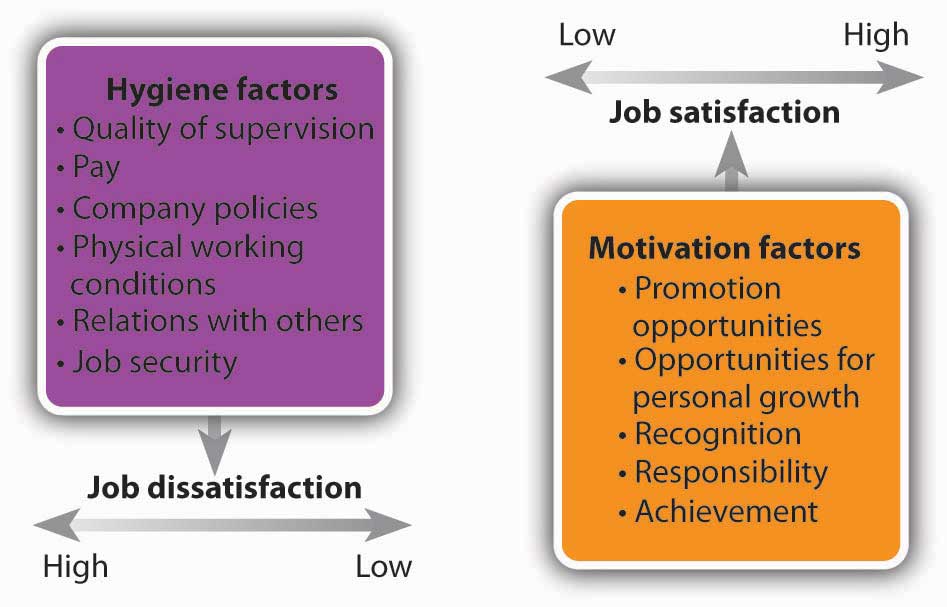 |
| Think about the classroom as you read these factors. |
The question then becomes, if we acknowledge that not paying students automatically serves to demotivate so many of them than how can we make up for it?
.... and here I thought I had the answer.
I will develop this thought further, but right now I want to point out how much better and potentially more fruitful this idea is for school's than the often touted hierarchy of needs from Maslow. I have heard Maslow's hierarchy used an excuse for not being able to reach students and help them achieve far too often, especially in high risk schools. For example, the situation at home is so detrimental to the student that they cannot be expected to become self-actualizing. What Herzberg is teaching me right now is that the classroom can circumvent or transcend some of those lower in the pyramid needs and help motivate a student towards self-actualization anyway.
I think I am definitely on to something here. For now I am going to read a little more from Herzberg (One More Time: How do you Motivate Employees) and then share these ideas with some colleagues and see what they have to say about things.
Please comment below I would love to hear from you.
Saturday, 8 March 2014
SMO Reflection Post #7 Rewards and Performance Management
Like almost all interactions between a manager, or a leader, and their employees performance appraisals should help an organization get the most out of an employee. The focus of this weeks material is how to get the most out of a performance appraisal, and the answer to this question is actually simple. In order to have an effective performance appraisal there needs to be a performance management system in place that is continous and ongoing. The flaws in most performance appraisal systems is that they are periodic and they are not systems that managers and employees understand and agree upon.
You know class this week was particularly interesting for a few reasons. First of all when the group who was presenting started doing their thing it was quite clear to most people (except the presenters it seems) that they were discussing the wrong article. They were supposed to reflect and report on the article on the motivational benefits of goal setting, but instead they were reflecting on the required reading on the feedback gap. The irony of this situation is that as a class we were all practising feedback avoidance behaviour (FAB). Several times during the presentation I was thinking that I should ask them a question about goal-setting or ask them why they were presenting this article, but I thought it wouldn't have been my place, or that it would have been mean to do to these three guys. I can only assume that Dr. Inness was also consideting letting them know as soon as they started presenting on the wrong article, but she must have made a management (leadership) decision that it is not a good idea. Operating under my thesis for this week, that feedback/appraisal should always get more out of employees, what would have been the best course of action for the group that was presenting? In this context getting more would mean increasing the quality of the entire classes understanding and future presentations. Arguments can be made for both courses of action, and I will not presume to make conclusions about that here, but it sure was an interesting experience of feedback avoidance. I can conclude, however, that sometimes feedback avoidance can have a positive impact on an organizations culture and performance, something not really explored in the article. I had another beef with the Feedback Gap article as well.
It is not as though the article made any kind of argument about gender and it's impact on management, but for some reason they included this gem, "Some evidence suggest that female managers are more likely to delay giving feedback and to positively distort feedback than male managers." A statement like that really needs to be defended and explored, and it has no place in this article. I wanted to find out what they were citing by "some evidence" and the referenced article was by Benedict and Levine, titled Delay and Distortion: Tacit Influences on Performance Appraisal Effectiveness (1988). The date of this article should instantly cause some concern because if they are using previous studies there is going to be the problem that I can only really call anachronistic discrimination or bias, so the first thing I was looking for in this article was original research.

It turns out that Benedict and Levine did conduct some original research. At the time of writing Benedict and Levine lamented that the influence of gender on PA ratings had not been systematically explored. Nonetheless they still revealed the prejudicial and anachronistic findings of the late '70s when they state that, "available research in this area suggests that women generally evaluate others more positively than do men." It is actually kind of amusing to read these academics writing in the late 1980's as they cite and reference garbage studies from the 1970s as their academic foundation. So, Benedict and Levine go on to conduct some original research to explore whether the findings of their predecessors are true or not, and this is waht they do. They take an equal number of male and female college students that all have a minimum of six months experience as supervisors in their field. This selection reveals the first flaw. I understand that they are working in a post-secondary institution, therefore they will select post-secondary students, but still this cannot be considered an adequate sample of supervisors. They have a sample of supervisors that, for whatever reason, are going back to school. They took this biased sample and then had the subjects of the experiment sit in a room with a confederate of the experiment. The subjects were tasked to review ten sessions worth of data supposedly about the confederates performance but actually manipulated by the experiments designers. The experiment measured how long (delay) the subjects took to schedule a negative performance review with the confederate and how accurate (distortion) the subjects negative performance appraisal of the confederate was. The confederate, by the way, was always the same 26 year old male.
What???
Yes, in a study around gender and interactions Benedict and Levine wanted to "avoid" the "interaction between rater and subordinate gender." Let me spell out this absurdity because this issue along really turns the study into garbage that should not be being cited by Moss and Sanchez in 2004. Benedict and Levine are trying to reach conclusions about the difference between how men and women treat employees in a PA. Then they choose a male as the only employee? This study on gender is purposefully ignoring the potential impact of gender! Why did they not choose a female employee to be the sole confederate? I will tell you why: BECAUSE IT WOULD CHANGE THE BLOODY RESULTS. There are other problems in this study and the conclusions that they reach suffice it to say, and I wish Moss and Sanchez would have considered this before they needlessly put in distracting indefensible statements about the impact of gender, any arguments about gender and management need to be supported by evidence, and some "evidence" needs to recognized as anachronistic garbage and rejected out of hand.
The final item that I really wanted to explore this week will certainly appear in the section on my personal leadership approach portion of the assignment. If there is going to be a performance appraisal system in the performance management system (there ought to be), then the performance metrics need to be very clear and very effective.
Currently, in education, there really aren't any performance metrics, so what would they look like in my field? When I am a leader in a school I will evaluate and communicate with teachers based on the following metrics:
| I didn't make this. |
It is not as though the article made any kind of argument about gender and it's impact on management, but for some reason they included this gem, "Some evidence suggest that female managers are more likely to delay giving feedback and to positively distort feedback than male managers." A statement like that really needs to be defended and explored, and it has no place in this article. I wanted to find out what they were citing by "some evidence" and the referenced article was by Benedict and Levine, titled Delay and Distortion: Tacit Influences on Performance Appraisal Effectiveness (1988). The date of this article should instantly cause some concern because if they are using previous studies there is going to be the problem that I can only really call anachronistic discrimination or bias, so the first thing I was looking for in this article was original research.
What???
Yes, in a study around gender and interactions Benedict and Levine wanted to "avoid" the "interaction between rater and subordinate gender." Let me spell out this absurdity because this issue along really turns the study into garbage that should not be being cited by Moss and Sanchez in 2004. Benedict and Levine are trying to reach conclusions about the difference between how men and women treat employees in a PA. Then they choose a male as the only employee? This study on gender is purposefully ignoring the potential impact of gender! Why did they not choose a female employee to be the sole confederate? I will tell you why: BECAUSE IT WOULD CHANGE THE BLOODY RESULTS. There are other problems in this study and the conclusions that they reach suffice it to say, and I wish Moss and Sanchez would have considered this before they needlessly put in distracting indefensible statements about the impact of gender, any arguments about gender and management need to be supported by evidence, and some "evidence" needs to recognized as anachronistic garbage and rejected out of hand.
The final item that I really wanted to explore this week will certainly appear in the section on my personal leadership approach portion of the assignment. If there is going to be a performance appraisal system in the performance management system (there ought to be), then the performance metrics need to be very clear and very effective.
Currently, in education, there really aren't any performance metrics, so what would they look like in my field? When I am a leader in a school I will evaluate and communicate with teachers based on the following metrics:
- Student performance evaluation. Students can tell school leadership if they perceive their teachers as Nice/Kind/Caring, as Prepared/Passionate/Inspiring and as Fair/Just.
- Teachers can be expected to submit a minimum number of common formative assessments with an anlysis of their assessment results based off of these CFAs (I won't get into the jargon, but CFAs have a very high effect size relative to another teaching tools in most of the best practice literature and meta-analysis).
- Students growth, measured against previous performance, in literacy. Short standardized tests can report this information easily.
- Students growth, measured against previous performance, in numeracy. Short standardized tests can report this information easily.
- Student evidence of artifacts of learning. Are there artifacts of learning that reveal student creativity, entrepreneurial spirit and love of learning?
I have never thought seriously about what specific metrics could be used to measure teacher effectiveness, and this week's lecture provided me with that opportunity. I now imagine a school where these metrics are communicated and agreed upon early in the school year and how that would shape the learning and teaching culture in a school.
 |
| Measured against agreed upon standards (metrics) |
Saturday, 1 March 2014
Some Things are Difficult to do Properly SMO 500 Reflection #6
Some things are difficult to do properly, and merit pay is certainly one of those things. In this post I will write from my own personal context as an educator and point to examples from the course literature for support in my arguments and reasoning while exploring the merits of performance pay.
Pay for Performance, one version of which is called Merit Pay, is hotly debated in the field of education. Many non-educators argue that Merit Pay could help fix perceived shortfalls in public education. The President of the Alberta Teachers' Association argues fervently against any form of pay for performance being incorporated into a collective bargaining discussion. Indeed, Alberta teachers can rest assured knowing that the dialogue will be D.O.A. if the government wants to even broach the topic. Certain districts and states in the United States do not have the security of a powerful and well entrenched professional association like the ATA, so they do have to at least consider implementing merit pay when negotiating salaries with their governments. This is a valuable opportunity to explore the nature of the resistance to merit pay, and to also explore the best methods of Rewards and Performance Management specifically from the lens of Public education.
 |
| It's Difficult to find images of Merit Pay that aren't entirely opposed to the idea. |
 |
| The ATA will never allow Merit Pay, but I can still get a little hypothetical in order to discuss my understanding of the issue. |
If merit pay were to be implemented in my school tomorrow there would be some teachers that would take immediate action in ensuring they could receive full performance pay. Those teachers would explore exactly what is necessary to receive the maximum pay for their work. They would research the criteria that they needed to fulfil, talk to their administrators about how exactly they would be measured against said criteria, work fervently towards achieving those goals (longer hours, more creative solutions to reaching their goals, more energy and passion in the classroom), constantly reflect on their progress towards meeting their goals, and they would also seek continual feedback from their peers and administrators about how well they are doing in reaching their goals. They would, in most situations involving this type of teacher, become so focused on reaching the goals outlined in the performance pay criteria that they would certainly not waste time building meaningful relationships with their students, or waste any time trying to motivate and work with students that are "lost causes." These teachers would be so focused on earning a pay check that they would not take time to help colleagues that wanted a little support or work with any students on non-academic issues. These teachers would almost certainly find a way to receive their full merit pay, or as much as possible given the criteria, but would the educational organization have benefited in the long-run?
The scenario above points to the first major flaw in performance pay systems. This flaw is also discussed in the literature around employee performance.
1. Pay is far too important to people. In the scenario above the teacher will not hesitate to ignore high-needs students, will not seek collegial understanding and collaboration (unless it furthers the teachers goal of meeting the performance pay criteria), would not waste time or energy on anything that does not bring the employee closer to the pay check, and they would most likely do all that they can to impress whoever it is that will be conducting the employee review. The teacher would also be far too tempted to behave unethically in order to achieve their goals. Further the teacher would come to resent students that take them further away from their goal. Not only would the teacher ignore positive relationship building opportunities, they would also create negative relationships with students that they perceive as not capable of helping the teacher reach goals.
Most people assume that a system of performance pay in education would revolve around academic goals that are measured by some form of standardized testing regime. Assuming that this testing regime could operate perfectly and actually assess academic growth, and not simply academic ability, there would still be considerable flaws in this system.
 |
| Every class would become test prep. |
I have worked with exams that do get an accurate measurement of foundational skills in numeracy and literacy. I quite like these exams because they are accurate snapshots of how students can read, understand and perform basic math skills. If I were to be measured on performance of these exams then I would spend all of my time practising and preparing for these exams. I would not waste time trying to nurture a love of reading or create wonder at the nature of mathematics. There would be no room for creative or critical thinking. It is impossible for me to picture a performance pay system in education that would not suck out all of the beautiful things I love about teaching. This idea also appears in the research around merit pay system and points to the second major flaw in pay for performance systems:
2. Merit Pay will Create Single-Minded Employees. Campbell, Campbell and Chia illustrate this problem quite effectively. They state that, "employees may only engage in those activities directly related to reward attainment." Employees operating with this kind of tunnel vision do not think about organizational goals or creating a positive and productive workforce, two critical traits of high-functioning employees.
Let's move this along towards conclusion.
As the title of this post suggests, it is very difficult to implement a fair and balanced system of performance pay properly which leads me to the final scenario and final major flaw in pay for performance systems.
At some point a manager must evaluate an employee. In the teaching scenario this would most likely be the school principal. Relationships among the educational leader and the educational agents would erode so quickly that the nature of the school would be fundamentally altered. Schools in Alberta have created a systems where the principal leads by example, expertise, assistance, motivation and character. All of those effective and critical dimensions of leadership would disappear and the principal would end up managing employees through evaluation. Teachers would not ask for assistance, they would not reveal any short-comings, they would hide from the principal or only give them positive reviews of their work. Principals would come to distrust employees, especially if their pay was also linked to performance of the school. Even if the Performance evaluation was completely based on academic performance criteria, and not subject to a management review the system would inevitably create an environment where certain teachers are perceived as favourites because they get the best kids or the best classes.
3. Merit Pay will Erode Genuine Leadership. In any complex organization it is extremely difficult to create a system that employees find fair. It is also extremely difficult, as pointed out in both articles from this week, to eliminate managerial abuses and managerial ineptitude.
There are many possible manifestations of Pay for Performance systems, but if the goal is to get the most out of every employee than none of these manifestations is superior to the best alternative to merit pay. I am forced once again to return to Daniel Pink's conclusion on what actually motivates people.
- Take money off the table. Pay people what they deserve and they will perform.
- Provide Autonomy
- Provide the opportunity to create Mastery
- Provide a Higher Purpose.
Perhaps the issue will continue to be debated in other organizations and in other fields, but I am happy that in my chosen line of work, and in my striving towards functional and effective leadership I do not have to worry about the corrosive idea of merit pay.
 |
| Merit Pay does not treat people as intelligent responsible Adults. |
Subscribe to:
Posts (Atom)