"The Principal builds trust and fosters positive working relationships based on the values and ethical foundations that reflect the school community."
"The Principal a) acts with fairness, dignity, and integrity plus g) supports processes for improving relationships and dealing with conflict within the school community."
I am on a journey of discovering the power of Restorative justice rather than punishment as a discipline model. This is difficult to achieve, but practice, awareness of opportunity and reflection are getting me closer to this goal.
Living in the space of restorative justice takes a shift of mindset, one that does not come easily or quickly. I have to be mindful of the restoration and learning opportunities in all situations.
The approach certainly does help foster more positive relationships because it treats all parties as valuable, that the offender and the victim have important lessons to learn. That there are no worthless people that deserve to be exiled, that all are worthy of fair treatment and reintegration into the positive community.
The most angry bully or vindictive student still feels like a victim on some level. By taking the time to understand the story of every actor one realizes what true fairness and dignity entails.
The process, in my present understanding works like this:
a) finding out information without involvement of people so that I can act with an idea of truth (investigation)
b) question those involved directly as individuals or in small groups in order to arrive at an agreed statement of facts
c) agreement and admission of guilt. What is the actual impact - I have hurt others with mean words. I have taken away from the safe feeling in the school.
d) creatively and without prejudgment arrive at an inverse act to counteract the harm done by the initial act.
I know that there are pieces of this process that need improving, but I am just getting started.
"The Principal b) demonstrates a sensitivity to and genuine caring for others and cultivates a climate of mutual respect plus c) promotes a respectful, inclusive school culture that honours diversity."
I am building a circle of courage school based on the values of belonging, mastery, independence and generosity. This foundation treats the entire human - student, teacher, staff - as an essential participant in their own life and the lives of those in the community. The most effective method in building up this culture is through a) my own conduct b) the homeroom character education program and c) staff professional development.
My students and staff are not fully aware of what the circle of courage is and what the values mean, and it is my task to educate them on this model and through this model.
"The Principal: d) acts in the best interest of all students plus e) models and promotes open, inclusive dialogue plus f) uses effective communication, facilitation, and problem-solving skills."
One of the key messages that works like magic in so many situations whether they are student-teacher, parent-teacher, or teacher-teacher is "Have you talked to the teacher?"
This phrase is a golden tool that all good principals must have learned along the way. It doesn't resolve everything, but it is a necessary first step that sends the message of importance, role, and power in the most effective way possible.
This is the starting point for fostering effective relationships.
"The Principal h) adheres to standards of professional conduct."
Everything I do I am considering the optics on my actions. It was a lesson that I had to learn early in my time as curriculum coordinator, but that internal dialogue, once embraced, grows and becomes ever-present. Every principal requires an active self-sensor. Emergent issue and quick decisions are thrust upon the principal regularly. The self-sensor gives me time to think before acting and my practice of asking for advice when needed is something I will always continue doing.
Friday, 13 May 2016


Friday, 6 May 2016
A Vision Finally
 |
| Google image search: Force Positive Change |
My personal vision in life, education, parenting and everything: To Force Positive Change
Force:
There is a negative connotation to this word, but one definition of Force is "strength or energy as an attribute of physical action or movement."
Positive:
Force cannot be neutral and change will occur no matter what. The key to my work is to define the positive in situations and act in that direction. The positive will be context specific, but a positive course of action can always be identified.
Change:
The only guarantee in life. Nothing is going to remain the same. All of the words I care about and am exposed to: history, First Nations Rights and Reality, Environment, student, energy, individual, Father, Participant. Everything is changing.
When I operate to Force Positive Change I am no longer at the mercy of the inevitable forces. Instead, I am taking an active role in an inevitable experience.
 |
| Enough said. |
I admit that I am not saying much with this post, but it is nice to have it out of the way, so that I can move on. This feels like a really nice fit for me and my vision. I will now go forth and Force Positive Change!
Monday, 18 April 2016
Leadership Dimension - Providing Instructional Leadership
"The Principal ensures that all students have ongoing access to quality teaching and learning opportunities to meet the provincial goals of education."
This is my second weakest dimension of the PQPS. Managing School operations and resources being my weakest. The latter is much easier to remedy with direct mentoring and knowledge. The former is more complex. Given that there is some circular logic within the goal" ensure teachers meet the Alberta TQS, to me this reads like too many bullets underneath bullets.
My approach to teacher motivation and instructional leadership has always fallen under Daniel Pink's version of motivation ie) autonomy, mastery, purpose (AMP). After a discussion last Friday with a teacher about this, however, it is clear that this model is lacking in what I can now recognize as acknowledgement.
Pink's AMP is by far more important than acknowledgement, but acknowledgement is where administration gets to signal what is the preferred approach. Autonomy, but this is what will be celebrated. Mastery and when achieved, this is what can be expected. Purpose, well we are teaching students to love learning, so that one is easy, but is excellence in meeting and caring for purpose ever acknowledged.
While studying the motivation and management of people the idea of incentive's often comes up, but there are no meaningful carrots and sticks within education. This is good from an AMP perspective, but how does one lead without incentives. The incentives signal what is valued. So how can that signalling take place? Public acknowledgement I suppose.
I always received lots of public acknowledgement, and it usually made me cringe to hear about it at a staff meeting, but I suppose that it is necessary. There still is something cringe worthy about just saying someones name at a staff meeting. I wonder how other leaders have handled this in the past? It can't be forced, and it can't be watered down.
The PQPS points to assessment, "appropriate and effective pedagogy that honours student diversity," "programming that meets individual student learning needs," new and emerging practices being integrated, communication with families, use of community resources, and of course AB. TQS adherence.
Thinking about this now, I suppose it is beholden upon me to find opportunities to acknowledge excellence in these fields.
Here are my big take-aways from this reflection on leadership dimension #5:
This is my second weakest dimension of the PQPS. Managing School operations and resources being my weakest. The latter is much easier to remedy with direct mentoring and knowledge. The former is more complex. Given that there is some circular logic within the goal" ensure teachers meet the Alberta TQS, to me this reads like too many bullets underneath bullets.
My approach to teacher motivation and instructional leadership has always fallen under Daniel Pink's version of motivation ie) autonomy, mastery, purpose (AMP). After a discussion last Friday with a teacher about this, however, it is clear that this model is lacking in what I can now recognize as acknowledgement.
Pink's AMP is by far more important than acknowledgement, but acknowledgement is where administration gets to signal what is the preferred approach. Autonomy, but this is what will be celebrated. Mastery and when achieved, this is what can be expected. Purpose, well we are teaching students to love learning, so that one is easy, but is excellence in meeting and caring for purpose ever acknowledged.
While studying the motivation and management of people the idea of incentive's often comes up, but there are no meaningful carrots and sticks within education. This is good from an AMP perspective, but how does one lead without incentives. The incentives signal what is valued. So how can that signalling take place? Public acknowledgement I suppose.
I always received lots of public acknowledgement, and it usually made me cringe to hear about it at a staff meeting, but I suppose that it is necessary. There still is something cringe worthy about just saying someones name at a staff meeting. I wonder how other leaders have handled this in the past? It can't be forced, and it can't be watered down.
The PQPS points to assessment, "appropriate and effective pedagogy that honours student diversity," "programming that meets individual student learning needs," new and emerging practices being integrated, communication with families, use of community resources, and of course AB. TQS adherence.
Thinking about this now, I suppose it is beholden upon me to find opportunities to acknowledge excellence in these fields.
Here are my big take-aways from this reflection on leadership dimension #5:
- Instructional Leadership - supporting, promoting, and being present for PLC work. This means showing up to team meetings, finding out what they are doing, and actively celebrating the good work being done here.
- Communicate that non-involvement in the classroom is due to my adherence to AMP for motivation and my deep faith in teacher ability.
- Using every public address to acknowledge one of the Leadership dimensions foci.
Sunday, 10 April 2016
Personal Vision
What is my personal vision for the work that I do? At this point I have only pieces of understanding. I do not have a clear understanding of my own purpose.
- Improving educational attainment for First Nations, Metis and Inuit students
- Leading schools to more equitable treatment of students
- Connecting students to real world change projects
- Creating a world that is kinder and more self-aware for my children.
Now how do I turn this into a personal vision?
The above was written as a final reflection for an MBA class on strategy. I left out some of my ideas on capitalism and environmentalism because I thought that the last two points captured my philosophical ground that the world is changing and that change ought to be good. I always thought that it was in Chinese philosophy, but the google (more specifically the Internet encyclopedia of philosophy), tells me that it was Heraclitus who talked about the nature of existence always changing and used the metaphor of the river.
According to both Plato and Aristotle, Heraclitus held extreme views that led to logical incoherence. For he held that (1) everything is constantly changing and (2) opposite things are identical, so that (3) everything is and is not at the same time. In other words, Universal Flux and the Identity of Opposites entail a denial of the Law of Non-Contradiction. Plato indicates the source of the flux doctrine: "Heraclitus, I believe, says that all things go and nothing stays, and comparing existents to the flow of a river, he says you could not step twice into the same river"
 |
| "On those stepping into rivers staying the same other and other waters flow." Heraclitus |
My personal application of this idea follows that every student is always different and how to reach them will continually change (the water), but the endeavour of teaching the love of learning (the river) will still remain the same. In this way, as I understand it, the river is always changing, and it is in awareness of this change that I am able to achieve unity of purpose.
So the world is changing, and my personal vision embraces this idea of change because it allows for the possibility of improvement. The horrors of the world and the cruelty that we all know is out there can be debilitating. Raising my family into this world I have to believe that improvements are not only possible, but inevitable. This foundation also suits the first two aspects of my personal vision from that reflection paper.
The EPSB vision is "Transforming the learners of today into the leaders of tomorrow."
I like that word transforming, but for now I am going to start crafting my own personal vision with the word change.
So far my personal vision is this: "Change ..."
The Goals of this Blog
There are three main goals that I wish to pursue in writing this. When I decided to get back into blog writing I thought this would be strictly to help me understand the PQP Standard. This would be an exercise in preparation and professional development, I thought. Since that time, however, I think that this could serve a bigger purpose than helping prepare me to be a principal. The last lecture I received from Dr. Marvin Washington challenged me to develop my own personal vision. One must be clear on what they want to lead and that takes consciousness. The EPSB vision: "Transforming the learners of today into the leaders of tomorrow" seems simple to understand at first, but there is much more behind this vision than a simple, build leadership skills kind of interpretation. Which leads me to the reasons I have for writing (these are not rank ordered),
- Deepen my understanding of the Principal Quality Practice Standard
- Application
- Examples
- Building up a PQPS segment in my brain
- Develop and refine my own personal Vision
- Clarity
- Not confined to my career only
- Reconciled with EPSB vision
- Deepen my understanding and application of this vision
- Explore career pathways for my future
- Based on clarity of vision
- Experimenting with what is possible
Now that I have started writing I can tell that this is often going to be a personal journal that is written only for me, but in the spirit of the millennial generation that I am not really a member of, I am going to put the whole thing out there online.
 |
| Vision determines Action |
Monday, 21 March 2016
PQPS Reflect Page 1
Here are the Principal Quality Practice Standards and my Individual Reflections on their application and interpretation.
Here we go ....
Here we go ....
Thursday, 21 May 2015
The most difficult thing I do
The hardest part of this job is, without a doubt, improving attendance rates for students that, for whatever reason, are not attending school.
There are certain demographic realities about the students that do not attend regularly, but more important than ethnic or economic pre-dispositions is the ineffectiveness of approach.
I was able to refine attendance monitoring this year. This enabled me to share up to date and accurate attendance figures with involved staff members and the students in question. At first talking to students about their attendance rates did have an impact. There was usually a temporary increase in attendance after meeting with a student. There was not, however, long-term improvements.
I know that the solution is to create meaningful connections with students that motivate them to attend. To reach an internal mechanism that proves the value of the relationship with the school to the student, but that task is so hard to do well.
The attendance board is sometimes effective, but usually in select cases. For something this complex there needs to be some kind of action research or best practices approach. I have a feeling that someone somewhere has a better solution. I just haven't heard from that person.
There are certain demographic realities about the students that do not attend regularly, but more important than ethnic or economic pre-dispositions is the ineffectiveness of approach.
I was able to refine attendance monitoring this year. This enabled me to share up to date and accurate attendance figures with involved staff members and the students in question. At first talking to students about their attendance rates did have an impact. There was usually a temporary increase in attendance after meeting with a student. There was not, however, long-term improvements.
 |
| I don't think a Truancy bot would fix the problem. |
The attendance board is sometimes effective, but usually in select cases. For something this complex there needs to be some kind of action research or best practices approach. I have a feeling that someone somewhere has a better solution. I just haven't heard from that person.
Tuesday, 10 March 2015
Just learning
The learning curve is steep, but I wouldn't want to be anywhere else. There is something exciting about knowing so little. It is akin to being lost while travelling: a little scary, done almost on purpose, and sure to provide lots of stories to tell for later.
There is a great deal to learn about the role that I must play now. There are certain tasks that an assistant principal is just expected to take care of, such as OHS, managing assessment requests, connecting students with district supports. The learning curve on those tasks is steep, but I do not feel a great deal of anxiety about being able to accomplish them. I take my job seriously, and I work hard. I have a supportive principal that is already picking up any pieces that I miss (and there are several), and the district that I work in understands that I am new to the role and bound to miss a little bit here and there. For the formal "task learning," therefore, there is a great deal of support, so I know I will get there.
The more interesting, and far more challenging, learning goal that I must now aspire to is how to lead in a school from a formal leadership position. One of the key items that I know staff are looking to me for in the school setting is on the nature of discipline. My approach to discipline and support of teachers in the classroom must be transparent and fair of course, but it should also take into account the teachers needs. What is it that a teacher needs to be able to teach more effectively in the classroom? This is such a difficult decision to make, but the best approach that I have seen modelled is one that is calm, decisive and honest. Calm and decisive are easy to interpret, but the honest part is a little unclear. By honest I mean the honesty to admit when I don't have the answer, to ask the teacher that is involved what their suggestions are and to listen to what the teachers are saying and not saying. There are many avenues that this exploration of learning about leadership can take, and I do hope to address more of them in future posts, but for now I want to stay focused on my commitment to respect staff when it comes to discipline. Fair, transparent and honest, that is the key to disciplinary leadership.
The final challenge that I want to reflect on here today is how to apply my current learning in my MBA program to my new role as AP. The class I am in right now is titled The Strategic Management of Innovation and Entrepreneurship. I had originally planned on writing about the challenge of finding the place for process innovation in a school, but it has just now dawned on me that rather than talk about how to do it I need to just do it. Starting after Spring Break our school will be preparing for the iCubed invention convention. This is a fantastic entry point for an innovative approach to instruction, timetabling and school organization. It is also the perfect place to leave this reflection, my first under the newly branded learn lead lead learn blog of mine that no one is really reading....
 |
| time x. |
| The organization is supportive of learning |
The final challenge that I want to reflect on here today is how to apply my current learning in my MBA program to my new role as AP. The class I am in right now is titled The Strategic Management of Innovation and Entrepreneurship. I had originally planned on writing about the challenge of finding the place for process innovation in a school, but it has just now dawned on me that rather than talk about how to do it I need to just do it. Starting after Spring Break our school will be preparing for the iCubed invention convention. This is a fantastic entry point for an innovative approach to instruction, timetabling and school organization. It is also the perfect place to leave this reflection, my first under the newly branded learn lead lead learn blog of mine that no one is really reading....
 |
| Next blog post: On the invention convention. |
Monday, 1 December 2014

Thursday, 2 October 2014
On Leadership and Role Modelling
There are two powerful ideas that stand out from my MBA studies so far.
- If you are serious about starting a business you need partners. This idea of real life collaboration can be applied in all sectors. For any project there are far too many things to accomplish alone. Success comes from finding and working with people that can share a vision, apply their myriad skills and make a project come to life.
- Transformational Leadership is the most effective style of leadership for any organization. This method of leadership shapes both how I conduct myself as a leader and the lens with which I view the other leaders in my organization.
Today I saw an example of Transformational Leadership, so that is what I am going to write about.
 |
| Transformational Leadership. |
While reading my news feed this morning I came across an opinion piece by Paula Simons called
Dentyne and Cheezies: Edmonton Public Schools’ boring expense reports are actually pretty exciting. At essence this is a story about transformational leadership.
It is a story about the managers, executive directors and board members behaving in a way that maintains the public trust. Spending responsibly, acting with the knowledge that they are under the watchful eye of the public, while still completing the important work that has been entrusted to them.
This kind of article does not get written and this kind of behavior does not occur by accident. There is an active example that has been set by our leaders, and it is the perfect example of both idealised influence and inspirational motivation (two facets of transformational leadership).
This is also just one example of how I have witnessed first hand the new leadership direction that possesses a tangible feeling within our board and throughout the district.
Because there is a certain tone to this short post that sounds like pandering (really though I genuinely feel proud of my organization) I will offer one brief criticism. I would really like to see the individual consideration that is necessary for transformational leadership to be complete. My interpretation of this segment has always included getting out into the front lines of any organization. For me as an acting assistant principal it means getting into the classrooms and the student spaces. For our board, particularly the assistant superintendents, I hope it means more visits to the schools themselves.
Friday, 5 September 2014
Reclaiming Youth at Risk, Part 1: The Seeds of Discouragement
I was given this book to read by my principal and it is lighting a fire in my thinking about the youth that we here at Westlawn so often encounter.
Reclaiming Youth at Risk: Our Hope for the Future by Larry Brendtro, Martin Brokenleg and Steve Van Bockern is a profoundly aware book. The empathy that is helping create in me is shaping how I think about students.
The authors accomplish this shift in thinking by changing the language that is used when discussing troubled youth. Simply by shifting the language used I am forced to change how I think about the students.
I have never really written a book review, and that is not what I intend to do here. I want to record some of the ideas that really resonate with me. In this process it will help me record my ideas for future use, and it will also help me to understand what they mean a little more deeply.
Understanding that the students who actively work against our best efforts to help them are "relationship-resistant" and view "even friendly helpful adults with deep distrust" is so helpful in helping us not take their resistance personally. I have so often heard people say, "the student isn't making any effort, so I am not going to keep trying to connect with him/her." We need to recognize that they are pushing us away as a defensive reaction. We should not expect them to respond with gratitude or to reciprocate our care.
The first part of this book on "the seeds of discouragement" also points out "our tendency to attribute problems to the troubled individual" and respond with coerciveness and avoidance when that individual doesn't act how we believe they should be acting. How can anyone, the authors challenge, "reject a child's behavior without implicitly rejecting the child?" Using Negative labels (like in the table above) taints the child as a person. The solution to helping reclaim youth is to shift away from a language of blame and toward a language of empathy.
I can hear all of my less empathetic family members and colleagues raising their challenges now. This is not about indulging destructive behavior or allowing youth to get away with everything because of their upbringing. It is about recognizing that the defiance and disrespect is an expression of frustration and discouragement. There is something very powerful in this linguistic shift because it impacts our fundamental perception of the behavior. Try it, it creates empathy.
Follow this logic from the text. We want the at risk youth to change and adopt positive behaviors and thoughts towards themselves, others around them and their own future right? Overindulgence of the youth's destructive behavior won't work. Authoritarian control and an insistence on complete obedience won't work in changing the youth's behavior either. "Young people seek help only from adults they see as caring and nurturing." We have to change how we talk and think about these children in order to create a mental environment that contains genuine care and concern. That comes from empathy.
Reclaiming Youth at Risk: Our Hope for the Future by Larry Brendtro, Martin Brokenleg and Steve Van Bockern is a profoundly aware book. The empathy that is helping create in me is shaping how I think about students.
The authors accomplish this shift in thinking by changing the language that is used when discussing troubled youth. Simply by shifting the language used I am forced to change how I think about the students.
 |
| I have taken the tables from the book and recreated them. I will use this image to guide the language that we, as a staff use when discussing students. |
I have never really written a book review, and that is not what I intend to do here. I want to record some of the ideas that really resonate with me. In this process it will help me record my ideas for future use, and it will also help me to understand what they mean a little more deeply.
Understanding that the students who actively work against our best efforts to help them are "relationship-resistant" and view "even friendly helpful adults with deep distrust" is so helpful in helping us not take their resistance personally. I have so often heard people say, "the student isn't making any effort, so I am not going to keep trying to connect with him/her." We need to recognize that they are pushing us away as a defensive reaction. We should not expect them to respond with gratitude or to reciprocate our care.
The first part of this book on "the seeds of discouragement" also points out "our tendency to attribute problems to the troubled individual" and respond with coerciveness and avoidance when that individual doesn't act how we believe they should be acting. How can anyone, the authors challenge, "reject a child's behavior without implicitly rejecting the child?" Using Negative labels (like in the table above) taints the child as a person. The solution to helping reclaim youth is to shift away from a language of blame and toward a language of empathy.
I can hear all of my less empathetic family members and colleagues raising their challenges now. This is not about indulging destructive behavior or allowing youth to get away with everything because of their upbringing. It is about recognizing that the defiance and disrespect is an expression of frustration and discouragement. There is something very powerful in this linguistic shift because it impacts our fundamental perception of the behavior. Try it, it creates empathy.
Follow this logic from the text. We want the at risk youth to change and adopt positive behaviors and thoughts towards themselves, others around them and their own future right? Overindulgence of the youth's destructive behavior won't work. Authoritarian control and an insistence on complete obedience won't work in changing the youth's behavior either. "Young people seek help only from adults they see as caring and nurturing." We have to change how we talk and think about these children in order to create a mental environment that contains genuine care and concern. That comes from empathy.
Friday, 29 August 2014
First week of 2014/2015 year
The students may not be here yet, but it feels like a full week of start-up tasks and activities has been accomplished. Yes, I will still have to come in for the weekend, but I did not want to leave school on the first week having already reneged on my promise to reflect through writing every week.
My mind is already stuffed with all of the things that I want to make sure I accomplish this long-weekend, so time to get writing about the past while it is still here in my memory.
What have I learned in this, my first week as "acting for" Assistant Principal?
My mind is already stuffed with all of the things that I want to make sure I accomplish this long-weekend, so time to get writing about the past while it is still here in my memory.
What have I learned in this, my first week as "acting for" Assistant Principal?
- All staff need to be taken care of. Sometimes it easy to see what different team members need to feel involved and supported and sometimes it is not so clear. The key is, however, to get into each of their classrooms while they are setting up and find out how they are doing. I was able to feel which staff are excited, which are a little bit scared, and which ones need some real support. I was able to offer that help and, hopefully show all of these team members that my first priority this week is supporting and listening to them. This is probably why I will have to come in on the weekend to accomplish some of my other tasks, but I am so glad I did it. I can't catch-up on staff relations over the weekend, but I can catch-up on all of the less important items on my to do list.
- Stay positive and responsive. This is really an extension of the first lesson I learned, but it bears repeating. It feels good to be a part of what all these wonderful teachers and teaching assistants are up to. I like that they will joke with me and keep me as part of their little groups.
- Schools will run themselves. This isn't true of course, but it is amazing how many things just happen because of the people behind the scenes that just make sure they are getting done. I don't know how, but I do know that when the students arrive everything is going to smoothly. I also know who is responsible.
This post seems a little empty for me, but I wrote it, and I will continue to take the time to reflect, no matter how much I want to get on moving out of here.
Until next week when the students arrive and the real work begins!!!
Wednesday, 25 June 2014
AIMSweb Report for Westlawn Staff 2013/2014
This is a report that I created for the staff of Westlawn school. It is a foray into whole school assessment data to inform programming.
Preamble
All results in this report indicate only that students performed better on the specific AIMSweb standardized assessments. There is no, as yet, indication that this will be reflected in teacher assigned grades, PAT exams or other, more general, measures of literacy and numeracy.
What was tested
There were four standardized exams that we used three times this year. All data in this report is sourced from these four exams.
Math Applications MCAP
|
Test of applied mathematics. There is an element of literacy in these questions. Questions typically ask students to use grade level numeracy skills to solve problems of varying complexity.
|
Math Computation MCOMP
|
Test of automaticity, speed and ease of recall when solving basic numeracy questions. Conversions, algebra, exponents, etc… There are no literacy requirements to answer these questions.
|
Reading Curriculum Based Measurement RCBM
|
This timed reading probe assesses a student's fluency and oral reading speed. There is significant research which argues that a student’s ability to read out loud is a key indicator of a student’s overall literacy level.
|
Reading Maze
|
This reading comprehension test measures how well a student understands a passage that they read silently.
|
On Percentile Scoring
All information is reported in Percentile Scores as measured against approximately 8000 Aimsweb students from the same grade level. Keep this in mind when interpreting scores. If a student is in the 50th %ile in September and they remain in the 50th %ile in June they have experienced the typical growth that should be expected. No change in %ile score indicates the growth experienced by that students peers. If the student experienced a 5%ile score increase, as reported in the attached spreadsheet that would indicate the student experienced typical growth in literacy or numeracy plus a rate of growth 5% higher when compared to peers.
No change in %ile score = regular and steady growth relative to peers.
|
Impact of Learning Strategies Options
Students in the numeracy learning strategies class (taught by Mr. Makowsky) showed the most significant improvement in their numeracy scores. There has been outstanding growth (45.5 %ile increase) on the MCOMP assessment, and there has been significant growth (27.5 %ile increase) on the MCAP assessment. This growth far outperforms the growth of the whole school population (4.3 %ile increase, 3.5 %ile increase respectively). Data was drawn from students in the two grade 8/9 option classes in semester two.
%ile Change Measured in June Compared to Fall Score
M-CAP
|
M-COMP
| |
Whole School
|
+ 3.5
|
+ 4.3
|
Learning Strategies Option Numeracy
|
+ 27.5
|
+ 45.5
|
Students in the literacy learning strategies class (taught by Mr. Greene) show some improvement in their literacy scores. There was significant growth (12.1 %ile increase) on the R-Maze assessment, but there was not a significant improvement on the RCBM assessment (5.1 %ile increase). This growth marginally outperforms the growth of the whole school population (3.1 %ile increase, 2.9 %ile increase respectively). Data was drawn from students in the two grade 8/9 option classes in semester two plus students in the grade seven option class from semester two.
%ile Change Measured in June Compared to Fall Score
R-CBM
|
R-Maze
| |
Whole School
|
+ 2.9
|
+ 3.1
|
Learning Strategies Option Literacy
|
+ 5.1
|
+ 12.1
|
See Appendix One - Learning Strategies Option/Whole School Comparison
Implications for Next Year
We must continue the learning strategies numeracy class with as little alteration to it as possible. Mr. Makowsky’s program of instruction, general pedagogical technique and specific lesson plans deserve to be recorded, documented and duplicated where possible. Implications of his instruction on other larger scale assessments should also be analyzed and discussed by the math team.
Key Finding: Mr. Makoswky has developed a highly effective math intervention program.
|
Learning Strategies Literacy should also continue, but the focus of instruction should be altered. There needs to be continued standardized assessment of student reading comprehension levels. Too many new techniques should be avoided. It would be advisable to develop a specific program for instruction, document the approach and analyze results at the end of term one to see if there are significant improvement to student reading comprehension. Any study of this intervention, however, would require whole school data in order to have a comparative group of students (we need a control group).
Impact of Homeroom Groupings.
We have called them homogenized, streamed and stratified, but whatever we decide to call them the data from AIMSweb assessments indicate that they do not work for all student levels. Surprisingly it turns out that the biggest impact has been for the lower level classes on their M-COMP performance (11.6 %ile increase). On the same test the higher level classes suffered a negative performance (3.6 %ile decrease). The middle group had a marginal increase in performance on the M-COMP (4.5 %ile increase). The M-CAP exam is worth mentioning as well because only the middle group had significant growth (9.2 %ile increase) while the lower and higher groups remained statistically unchanged (2.2 %ile increase, 0.9 %ile decrease respectively). There was no impact on the R-CBM or R-MAZE that is worth reporting. Data was drawn by grouping the 7-1, 8-2, 9-1 as the low group, 7-2, 8-1, 9-2 as the middle group and 7-3, 8-3, 9-3 as the high group. Keep in mind that the High Group scores were quite high in September(see graphs in appendix two), and that we moved high performing students from the low to the middle group and from the middle to the high group.
%ile Change Measured in June Compared to Fall Score
RCBM
|
RMAZE
|
MCAP
|
MCOMP
| |
Whole School
|
+ 2.9
|
+ 3.1
|
+ 3.5
|
+ 4.3
|
Low Classes
|
+ 3.2
|
+ 3.1
|
+ 2.2
|
+ 11.6
|
Middle Classes
|
+ 2.3
|
+ 4.6
|
+ 9.2
|
+ 4.5
|
High Classes
|
+ 3.1
|
+ 1.6
|
- 0.09
|
- 3.1
|
See Appendix - Two Homeroom Grouping Comparisons
Implications for Next Year
There is no impact of this years homeroom groupings on these measures of literacy and numeracy. In the interest of studying the impact of homeroom groupings I would argue that next year we attempt full inclusion, heterogeneous groupings with an equal mix of high performing and low performing students in each class. We should then keep accurate measurements to see if this grouping of students impacts student performance on basic literacy and numeracy assessments.
My Point of View: based on the results of this year and using the same logic that led to homogenous groupings ie) let’s try it and see, I recommend that we eliminate the learning strategies homeroom classes and adopt a model of full inclusion.
|
Assessment Plan for Next Year
We ought to keep the M-COMP measurement because it is easy to implement and measure. The math team has also suggested that we go back to using the CAT exam, but we would have to purchase the CAT IV.
The one on one RCBM assessment should be kept because it provides the most accurate picture of a student's reading ability, but it should be administered by the language arts teachers so that they experience the first hand knowledge that this test has to offer.
There is one more key finding that is difficult to pull out of the data, but that I can offer up based on my experience having every student read to me and then discussing their results with them. In the June exam after every student heard their RCBM score (and found out whether or not it had changed significantly since the fall), I asked them why they thought they got the results that they did. Indeed some students had remarkable growth, so I asked them to explain themselves. One common finding came up again, again and again.
Key Finding: Students that were reading on their own time, for enjoyment, had remarkable and significant growth on the RCBM assessment. This finding was universal, regardless of the students initial score on the September assessment.
|
The implication of this second key finding is that our literacy intervention plan should be built around the idea of increasing students authentic love of reading. For some, extrinsic rewards can help pull students out of their literacy deficit, but for most simply making the love of reading an often talked about value that is part of our school culture and assessment practice will be enough to increase literacy scores. Of course how to accurately track and record this will take additional research on which standardized literacy measures are better than AIMSweb.
Appendix One Learning Strategies Option/Whole School Comparison
These Graphs represent real %ile scores over time, not change in %ile score over time. 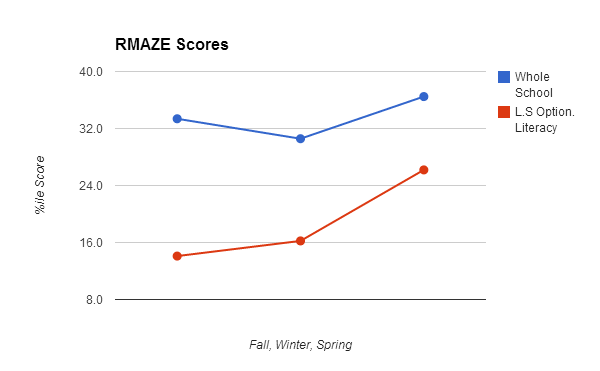


Appendix Two Homeroom Grouping Comparisons
These Graphs represent real %ile scores over time, not change in %ile score over time.


Wednesday, 7 May 2014
Moving Forward with Project Based Instruction
Some fantastic Project Based Learning Ideas are floating around in the building today.
From correspondence with the teams this is what is on it's way to happening for PBL at Westlawn.
Math has identified certain units that lend themselves well to projects. They have also noted that there is a lot of potential in the higher stream classes for projects because, as far as teaching essential outcomes is concerned, they have been able to cover so much more this year. Additionally, they have identified some projects that can be beneficial for our 7-1 and 8-2 classes. This is what we can anticipate from Math:
- Silly Students, Fruit Loops are for counting. aka) don't eat the fruit loops
- Plane Games. You need all Coordinates to Survive!
- Space Station Shapes Station - Good possible link to science here.
- The Geometry of Westlawn School - A study using google maps and the building where we learn. Good Social Studies Geography Link here.
Science is working on an exciting Grade 9 Space Based Research Project. All of us can play a role in getting all of our grade nine students excited about research into Space.
The Grade Sevens are also doing some kind of Plant Project. I don't have much detail yet about this one, but we can all talk to our grade sevens about agriculture, math and crops, or help find some poems and stories written about food (The Grapes of Wrath is probably out of reach, but there must be something). Maybe students can create LA objects that document whatever Plant Projects are being created! Great work Science, you are always a step ahead.
LA and Social have dutifully assessed the writing of every single student in this school. That takes a great deal of mental energy, so thank you humanities team. I know they have some strong ideas brewing, and I can't wait to hear what they come up with. Grade Eights are studying the idea of social structure and global relationships through the Aztecs, so if anyone has some good ideas about how to turn that into an exciting project make sure you pass them along to humanities.
TLDR:
Grade 7 - Fruit Loops Counting and Analysis and/or Coordinate Planes Games (maybe)
Grade 8 - Aztec something something awesome
Grade 9 - Space, how could you not love learning about space?
You are all agents of motivation, doing noble work and it is beautiful!
 |
| These are Westlawn's Projects! Poster Created using Adobe InDesign |
Subscribe to:
Posts (Atom)