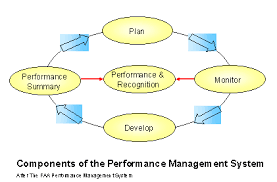
Like almost all interactions between a manager, or a leader, and their employees performance appraisals should help an organization get the most out of an employee. The focus of this weeks material is how to get the most out of a performance appraisal, and the answer to this question is actually simple. In order to have an effective performance appraisal there needs to be a performance management system in place that is continous and ongoing. The flaws in most performance appraisal systems is that they are periodic and they are not systems that managers and employees understand and agree upon.
 |
| I didn't make this. |
You know class this week was particularly interesting for a few reasons. First of all when the group who was presenting started doing their thing it was quite clear to most people (except the presenters it seems) that they were discussing the wrong article. They were supposed to reflect and report on the article on the motivational benefits of goal setting, but instead they were reflecting on the required reading on the feedback gap. The irony of this situation is that as a class we were all practising feedback avoidance behaviour (FAB). Several times during the presentation I was thinking that I should ask them a question about goal-setting or ask them why they were presenting this article, but I thought it wouldn't have been my place, or that it would have been mean to do to these three guys. I can only assume that Dr. Inness was also consideting letting them know as soon as they started presenting on the wrong article, but she must have made a management (leadership) decision that it is not a good idea. Operating under my thesis for this week, that feedback/appraisal should always get more out of employees, what would have been the best course of action for the group that was presenting? In this context getting more would mean increasing the quality of the entire classes understanding and future presentations. Arguments can be made for both courses of action, and I will not presume to make conclusions about that here, but it sure was an interesting experience of feedback avoidance. I can conclude, however, that sometimes feedback avoidance can have a positive impact on an organizations culture and performance, something not really explored in the article. I had another beef with the Feedback Gap article as well.
It is not as though the article made any kind of argument about gender and it's impact on management, but for some reason they included this gem, "Some evidence suggest that female managers are more likely to delay giving feedback and to positively distort feedback than male managers." A statement like that really needs to be defended and explored, and it has no place in this article. I wanted to find out what they were citing by "some evidence" and the referenced article was by Benedict and Levine, titled
Delay and Distortion: Tacit Influences on Performance Appraisal Effectiveness (1988). The date of this article should instantly cause some concern because if they are using previous studies there is going to be the problem that I can only really call anachronistic discrimination or bias, so the first thing I was looking for in this article was original research.

It turns out that Benedict and Levine did conduct some original research. At the time of writing Benedict and Levine lamented that the influence of gender on PA ratings had not been systematically explored. Nonetheless they still revealed the prejudicial and anachronistic findings of the late '70s when they state that, "available research in this area suggests that women generally evaluate others more positively than do men." It is actually kind of amusing to read these academics writing in the late 1980's as they cite and reference garbage studies from the 1970s as their academic foundation. So, Benedict and Levine go on to conduct some original research to explore whether the findings of their predecessors are true or not, and this is waht they do. They take an equal number of male and female college students that all have a minimum of six months experience as supervisors in their field. This selection reveals the first flaw. I understand that they are working in a post-secondary institution, therefore they will select post-secondary students, but still this cannot be considered an adequate sample of supervisors. They have a sample of supervisors that, for whatever reason, are going back to school. They took this biased sample and then had the subjects of the experiment sit in a room with a confederate of the experiment. The subjects were tasked to review ten sessions worth of data supposedly about the confederates performance but actually manipulated by the experiments designers. The experiment measured how long (delay) the subjects took to schedule a negative performance review with the confederate and how accurate (distortion) the subjects negative performance appraisal of the confederate was. The confederate, by the way, was always the same 26 year old male.
What???
Yes, in a study around gender and interactions Benedict and Levine wanted to
"avoid" the "interaction between rater and subordinate gender." Let me spell out this absurdity because this issue along really turns the study into garbage that should not be being cited by Moss and Sanchez in 2004. Benedict and Levine are trying to reach conclusions about the difference between how men and women treat employees in a PA. Then they choose a male as the only employee? This study
on gender is purposefully ignoring the potential impact
of gender! Why did they not choose a female employee to be the sole confederate? I will tell you why:
BECAUSE IT WOULD CHANGE THE BLOODY RESULTS. There are other problems in this study and the conclusions that they reach suffice it to say, and I wish Moss and Sanchez would have considered this before they needlessly put in distracting indefensible statements about the impact of gender, any arguments about gender and management need to be supported by evidence, and some "evidence" needs to recognized as anachronistic garbage and rejected out of hand.
The final item that I really wanted to explore this week will certainly appear in the section on my personal leadership approach portion of the assignment. If there is going to be a performance appraisal system in the performance management system (there ought to be), then the performance metrics need to be very clear and very effective.
Currently, in education, there really aren't any performance metrics, so what would they look like in my field? When I am a leader in a school I will evaluate and communicate with teachers based on the following metrics:
- Student performance evaluation. Students can tell school leadership if they perceive their teachers as Nice/Kind/Caring, as Prepared/Passionate/Inspiring and as Fair/Just.
- Teachers can be expected to submit a minimum number of common formative assessments with an anlysis of their assessment results based off of these CFAs (I won't get into the jargon, but CFAs have a very high effect size relative to another teaching tools in most of the best practice literature and meta-analysis).
- Students growth, measured against previous performance, in literacy. Short standardized tests can report this information easily.
- Students growth, measured against previous performance, in numeracy. Short standardized tests can report this information easily.
- Student evidence of artifacts of learning. Are there artifacts of learning that reveal student creativity, entrepreneurial spirit and love of learning?
I have never thought seriously about what specific metrics could be used to measure teacher effectiveness, and this week's lecture provided me with that opportunity. I now imagine a school where these metrics are communicated and agreed upon early in the school year and how that would shape the learning and teaching culture in a school.
 |
| Measured against agreed upon standards (metrics) |


No comments:
Post a Comment